
In the macro context of 2026, ARK Invest points out that there are four major trends that are increasing the value of Bitcoin, and believes that Bitcoin is evolving from an “optional” marginal asset to an indispensable strategic asset in institutional portfolios. The following are the details.
In 2025, Bitcoin continues to deeply integrate into the global financial system. With the launch and growth of Bitcoin spot ETFs in 2024 and 2025, the inclusion of digital asset listed companies in major stock indices, and the continuous improvement of regulatory transparency, Bitcoin is being driven from the fringes to a new asset class that ARK Invest believes is worthy of institutional asset allocation.
ARK Invest believes that the core theme of this cycle is the transformation of Bitcoin: from an “optional” emerging monetary technology to a strategic allocation asset in the eyes of more and more investors. There are four major trends that are enhancing Bitcoin’s value proposition:
The macro and policy context that shapes the demand for scarce digital assets
Structural ownership trends covering ETFs, corporations and sovereign states
The relationship between Bitcoin and gold and the broader means of storing value
Compared with previous cycles, the magnitude and volatility of Bitcoin’s retracements are decreasing
This article will elaborate on these trends in detail.
01 2026 Macroeconomic Background
Monetary Conditions and Liquidity
After a long period of monetary tightening, the macro landscape is changing: the US quantitative tightening (QT) ended last December, and the Federal Reserve’s rate cut cycle is still in its early stages. In addition, more than $10 trillion in low-yield money market funds and fixed income ETFs may be about to rotate into risk assets.
Policy and Regulatory Normalization
Regulatory transparency is both a constraint on institutional adoption and a potential catalyst. In the United States and other countries, policymakers have been advancing frameworks designed to clarify digital asset regulation, standardize custody, trading, and disclosure processes, and provide more guidance to institutional allocators.
For example, the US CLARITY Act, if implemented—that is, the Commodity Futures Trading Commission (CFTC) regulates digital commodities, and the Securities and Exchange Commission (SEC) regulates digital securities—will significantly reduce the compliance uncertainty for companies and institutions focused on digital assets. The bill provides a compliance roadmap for the life cycle of digital assets, allowing tokens to be transferred from SEC to CFTC regulation after decentralization through a standardized “maturity test”. The bill implements a dual registration system for broker-dealers, reducing the legal “vacuum” in which digital asset companies have historically operated offshore.
The US government has also addressed issues related to Bitcoin by:
Legislators discussing incorporating Bitcoin into the national reserve.
Regulating the management of seized Bitcoin holdings (currently mostly controlled by the federal government).
State-level adoption of Bitcoin, with Texas leading the way, having purchased and incorporated it into the state reserve.
02 Structural Demand: ETFs and DATs
ETFs as Structural New Buyers
The large-scale expansion of spot Bitcoin ETFs has reshaped the market’s supply and demand landscape. As shown in the figure below, by 2025, the amount of Bitcoin absorbed by US Bitcoin spot ETFs and DATs is 1.2 times the sum of newly mined Bitcoin and dormant Bitcoin that has re-entered the market (active supply growth). By the end of 2025, the total amount of Bitcoin held by ETFs and DATs exceeds 12% of the total circulating supply. Although the growth in demand for Bitcoin exceeded the growth in supply, its price fell, which seems to be affected by external factors: a large-scale liquidation event triggered by a software failure on October 10, concerns about the four-year cycle turning point of Bitcoin, and negative sentiment surrounding the threat of quantum computing to Bitcoin encryption technology.
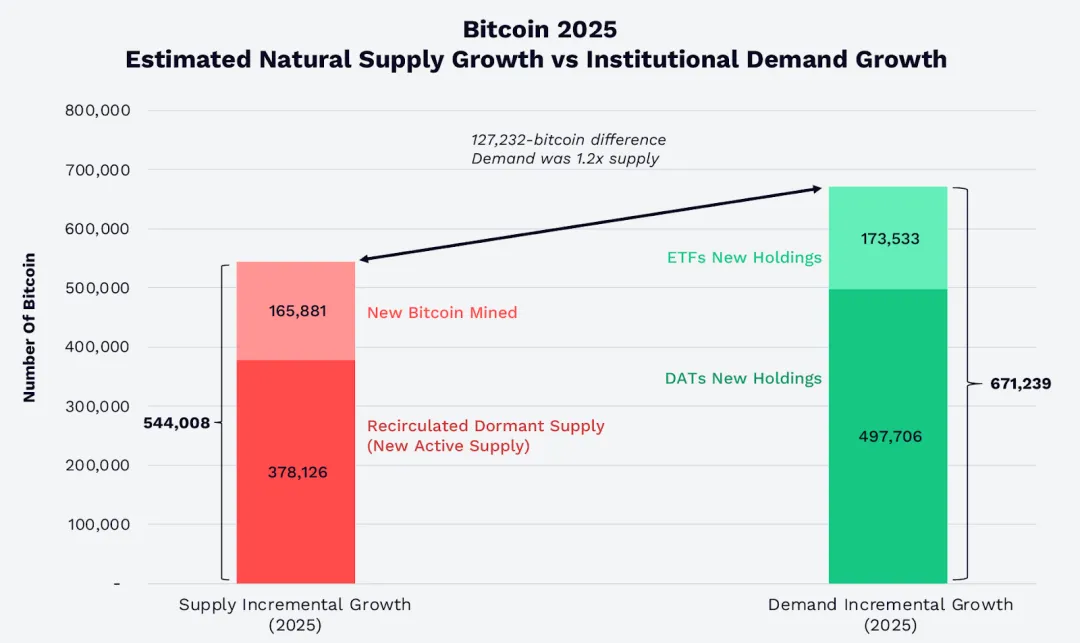
Source: ARK Investment Management LLC and 21Shares, 2026 forecast, data from Glassnode, as of December 31, 2025.
In the fourth quarter, Morgan Stanley and Vanguard incorporated Bitcoin into their investment platforms. Morgan Stanley expanded its customers’ access to compliant Bitcoin products, including spot ETFs. Surprisingly, Vanguard also added third-party Bitcoin ETFs to its platform after years of rejecting cryptocurrencies and all commodities. As ETFs mature, they will increasingly play a structural bridge role connecting the Bitcoin market with traditional pools of capital.
Bitcoin-related companies in the index, corporate adoption, and Bitcoin reserves
Corporate adoption of Bitcoin is no longer limited to a few early adopters. The S&P 500 and Nasdaq 100 indices have incorporated the stocks of companies such as Coinbase and Block, introducing Bitcoin-related exposure into mainstream portfolios. Previously known as MicroStrategy, the company, as a DAT entity, has established a large Bitcoin position, accounting for 3.5% of the total supply. In addition, Bitcoin DAT companies currently hold over 1.10 million BTC, accounting for 5.7% of the supply (worth approximately $89.90 billion as of the end of January 2026). To a large extent, these corporate reserves are long-term holders rather than short-term speculators.
Sovereign States and Strategic Reserves
In 2025, following El Salvador, the Trump administration used seized Bitcoin to establish the US Strategic Bitcoin Reserve (SBR). Today, the reserve holds approximately 325,437 BTC, accounting for 1.6% of the total supply, worth $25.60 billion.
03 Bitcoin and Gold as Stores of Value
Gold Leads, Bitcoin Follows?
In recent years, gold and Bitcoin have responded differently to macro narratives such as currency devaluation, negative real interest rates, and geopolitical risks. In 2025, gold prices soared 64.7% due to inflation concerns and fiat currency devaluation. Somewhat surprisingly, Bitcoin prices fell 6.2%, a divergence that is not unprecedented.
In 2016 and 2019, gold price increases preceded Bitcoin. During the COVID-19 shock in early 2020, the surge in fiscal and monetary liquidity and the rise in gold prices also foreshadowed the rise in Bitcoin. As shown in the figure below, this “gold-Bitcoin” pattern was particularly evident in 2017 and 2018. Will history repeat itself? According to historical relationships, Bitcoin is a high-beta, digitally native extension of the same macro trading logic that has historically supported gold.
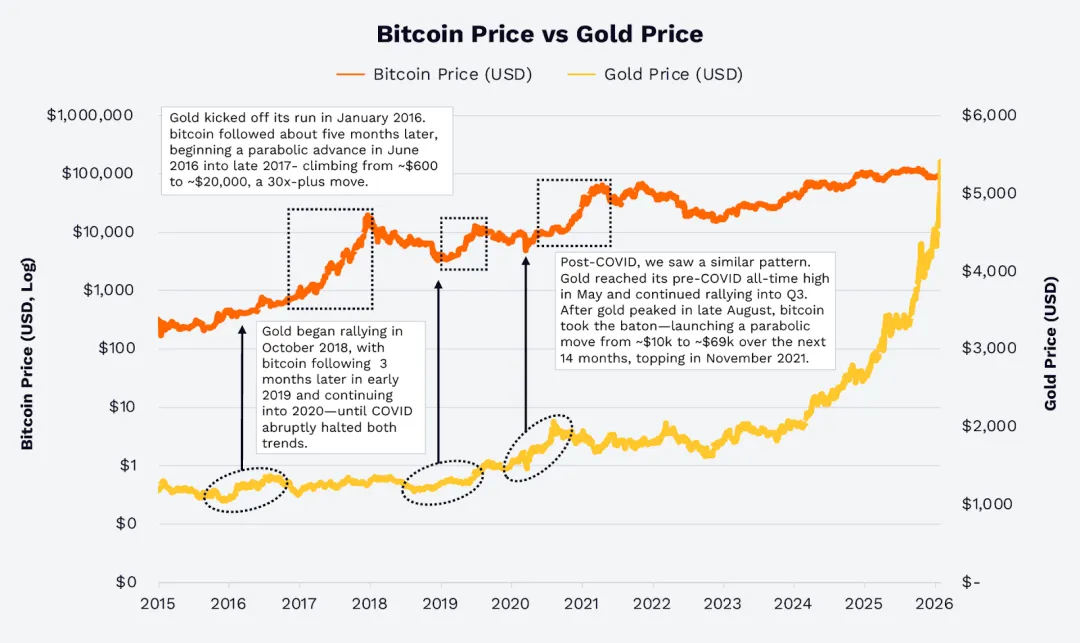
Source: ARK Investment Management LLC and 21Shares, 2026, data from Glassnode and TradingView, as of January 31, 2026.
ETF Assets Under Management: Bitcoin’s Share is Growing
Cumulative ETF net inflows provide another comparative dimension between Bitcoin and gold. According to data from Glassnode and the World Gold Council, spot Bitcoin ETFs have achieved the level that gold ETFs took more than 15 years to reach in less than two years, as shown in the figure below. In other words, financial advisors, institutions, and retail investors seem to be more accepting of Bitcoin’s role as a store of value, a diversified investment tool, and a new asset class.
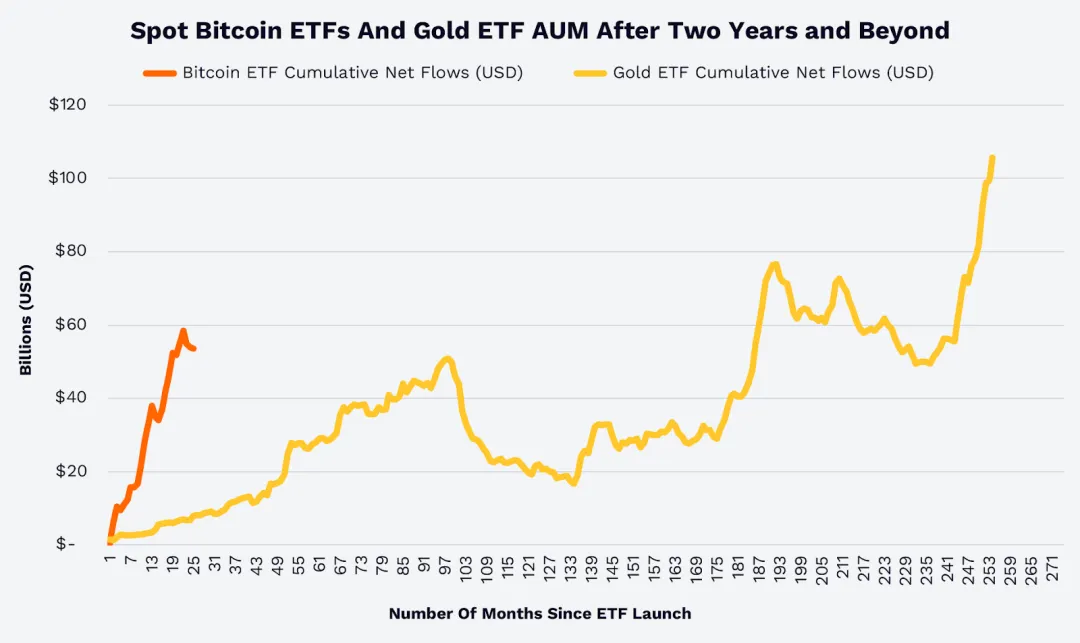
Source: ARK Investment Management LLC and 21Shares, 2025, data from Glassnode and the World Gold Council, as of December 31, 2025.
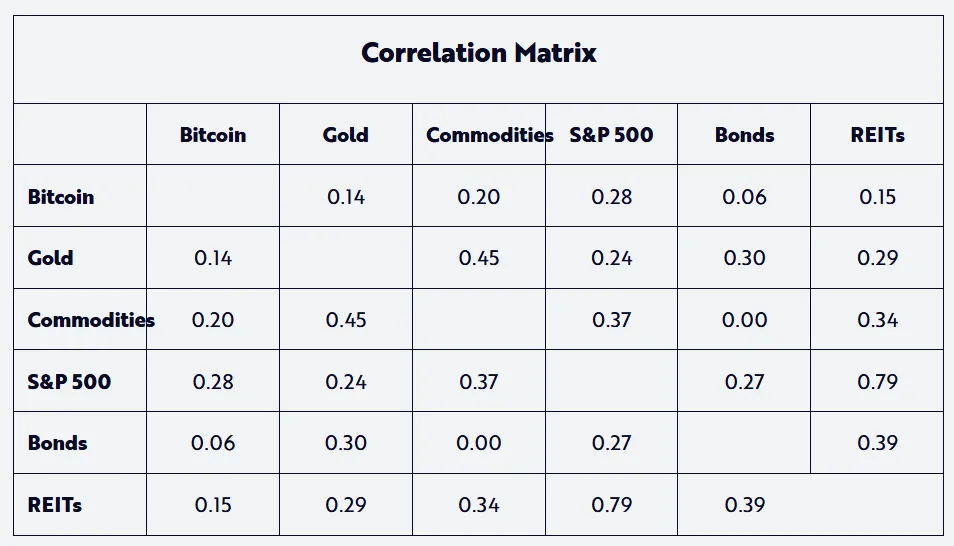
It is worth noting that, as shown in the figure below, the correlation between Bitcoin and gold returns in the previous cycle has been very low since 2020. That is to say, gold may be a leading indicator.
Image
Note: The above correlation matrix uses weekly return data from January 1, 2020 to January 6, 2026.
04 Market Structure and Investor Behavior
Retracements, Volatility, and Market Maturity
Bitcoin is a volatile asset, but its retracement magnitude has decreased over time. In previous cycles, peak-to-trough declines often exceeded 70–80%. In the current cycle since 2022 (as of February 8, 2026), the magnitude of the pullback from the historical high has not exceeded approximately 50% (as shown below). This suggests that even in the face of significant corrections (such as the adjustment that occurred in the first week of February 2026), the market is performing more robustly due to increased participation and deepening liquidity.
Source: ARK Investment Management LLC and 21Shares, 2025 forecast, data from Glassnode, as of January 31, 2026.
These observations suggest that Bitcoin is transforming from a speculative asset into a globally tradable macro financial instrument, with increasingly diverse holders and supported by a robust trading, liquidity, and custody infrastructure.
Long-Term Holding vs. Market Timing
According to Glassnode data, assuming a “worst-luck” Bitcoin investor invests $1,000 at the highest price each year from 2020 to 2025, his investment of approximately $6,000 would increase to approximately $9,660 by December 31, 2025, and to approximately $8,680 by January 31, 2026, with returns of approximately 61% and 45%, respectively (as shown below). Even considering the pullback in early February, this investment would reach $7,760 by February 8, with a return of approximately 29%.
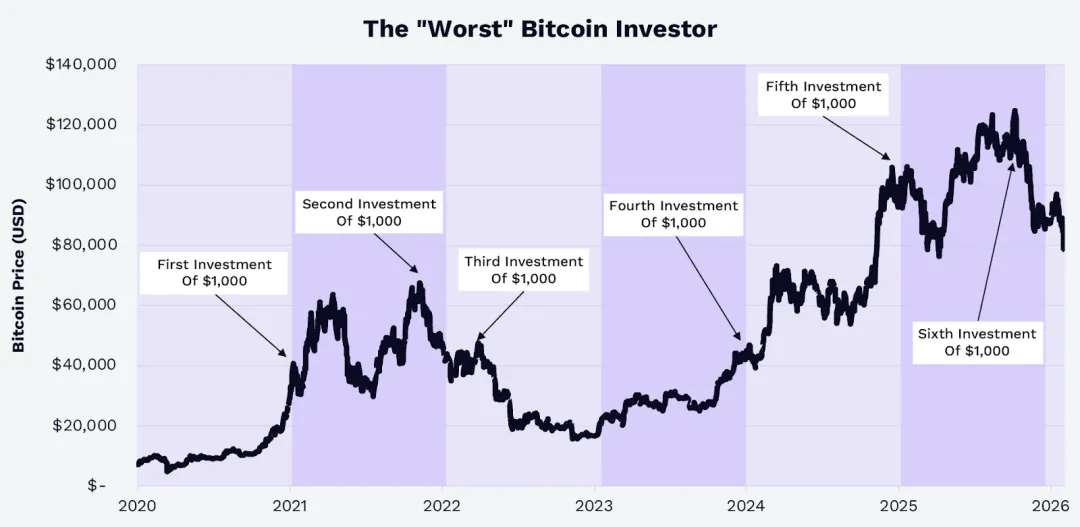
Source: ARK Investment Management LLC and 21Shares, 2026, data from Glassnode, as of January 31, 2026
This shows that since 2020, holding period and position size have been more important than when to buy: the market usually rewards investors who focus on Bitcoin’s value proposition rather than its volatility.
05 Bitcoin’s Strategic Issues Today
In 2026, the narrative for Bitcoin is no longer about whether it can “survive,” but about its role in a diversified investment portfolio. Bitcoin is:
A scarce, non-sovereign asset in the context of evolving global monetary policy, government deficits, and trade deficits.
A high-beta extension of traditional store-of-value assets such as gold.
A globally liquid macro tool accessible through regulated instruments.
As regulatory and infrastructure advances ease barriers to entry, long-term holders, including ETFs, corporations, and sovereign entities, have absorbed a significant amount of new Bitcoin supply. Historical data also suggests that allocating to Bitcoin has the potential to improve a portfolio’s risk-adjusted returns, especially after its volatility and retracement magnitude have declined over a full market cycle, due to Bitcoin’s low correlation with other assets, including gold.
ARK Invest believes that when investors evaluate this new asset class in 2026, the question they face is no longer “whether” to allocate to Bitcoin, but “how much” to allocate and “through what channels”.
[ARK Invest]
ARK Invest’s Bitcoin Thesis: From Speculative Asset to Strategic Institutional Allocation
ARK Invest’s latest analysis presents a compelling narrative for Bitcoin’s evolution from a marginal, speculative asset to an indispensable strategic component of institutional portfolios. The four major trends identified—macroeconomic drivers, structural ownership, the Bitcoin-gold relationship, and decreasing volatility—paint a picture of a maturing asset class experiencing fundamental shifts in market dynamics and investor perception.
The Macro Transformation
The most significant development is Bitcoin’s integration into the global financial system, evidenced by the absorption of 1.2x the active supply growth through ETFs and DATs by 2025. This structural demand, exceeding new mining and dormant coin re-entry, creates a powerful floor under the market that didn’t exist in previous cycles. The end of US quantitative tightening and the potential rotation of $10 trillion from low-yield instruments into risk assets further strengthens Bitcoin’s macroeconomic rationale as a non-sovereign store of value in an environment of currency devaluation and government deficits.
The regulatory normalization through frameworks like the CLARITY Act represents a critical inflection point. By establishing clear compliance pathways and reducing the legal “vacuum” that has historically plagued digital assets, regulatory clarity is transforming Bitcoin from a compliance risk to a compliant institutional investment. The US Strategic Bitcoin Reserve holding 325,437 BTC (1.6% of supply) and state-level adoption by pioneers like Texas further institutionalize Bitcoin’s status as a strategic asset.
Market Structure Evolution
The decreasing magnitude of Bitcoin’s retracements—from 70-80% in previous cycles to approximately 50% in the current cycle—signals genuine market maturation. This reduction in volatility, coupled with increasing liquidity and diverse holders, suggests Bitcoin is transitioning from a speculative vehicle to a globally tradable macro financial instrument. The historical data showing positive returns even for “worst-luck” investors (buying at yearly peaks) since 2020 reinforces the thesis that holding period has become more critical than market timing.
The divergence between gold and Bitcoin in 2025 (gold up 64.7%, Bitcoin down 6.2%) is particularly telling. While ARK identifies this as following a historical pattern where gold leads Bitcoin, it also highlights that Bitcoin’s price action remains influenced by factors beyond macroeconomic narratives—including technical failures, cycle concerns, and emerging risks like quantum computing. This suggests Bitcoin, while increasingly correlated with traditional macro assets, retains unique characteristics that affect its price independently.
Strategic Implications and Market Impact
The article’s conclusion that the question has shifted from “whether” to allocate to “how much” to allocate represents a milestone in Bitcoin’s market evolution. This reframing positions Bitcoin not as a replacement for traditional assets but as a diversification tool with low correlation to other assets, including gold. The rapid growth of Bitcoin ETFs, reaching gold ETF’s AUM levels in less than two years versus 15+ years for gold, indicates a more rapid acceptance of Bitcoin’s value proposition by financial advisors, institutions, and retail investors.
For the broader crypto market, Bitcoin’s institutionalization likely means increased correlation with traditional markets, which could reduce its appeal as a pure hedge but enhance its legitimacy as an asset class. The inclusion of Bitcoin-related companies in major indices (S&P 500, Nasdaq 100) provides indirect exposure and further legitimizes the crypto ecosystem, potentially attracting capital that might not directly enter the crypto market.
Risks and Considerations
Despite the optimistic thesis, significant risks remain. The increasing correlation with traditional markets as Bitcoin becomes more integrated could amplify drawdowns during broader market stress. Government intervention in Bitcoin markets, particularly through seized Bitcoin holdings, creates regulatory uncertainty that investors must monitor. Additionally, the potential for valuation concerns as more institutional players enter could lead to market saturation.
The quantum computing threat to Bitcoin’s encryption, while perhaps overstated in the short term, represents a legitimate long-term technological risk that investors should track. Similarly, the concentration of Bitcoin ownership among corporations and sovereign entities introduces new dynamics that could impact market liquidity and price discovery.
Investment Opportunities
For experienced crypto investors, ARK’s analysis suggests several strategic opportunities:
-
Long-term Bitcoin allocation: The decreasing volatility and structural demand trends create a more favorable risk-reward profile for strategic, long-term positions.
-
Infrastructure and service providers: The growth of ETFs and regulated custody services creates opportunities for service providers bridging traditional and digital asset markets.
-
Bitcoin-related equities: Companies like Coinbase and Block, now part of major indices, offer indirect exposure to Bitcoin’s growth story.
-
Diversification strategies: Bitcoin’s low correlation with other assets, including gold, offers diversification benefits that sophisticated investors can leverage.
In conclusion, ARK Invest’s analysis provides a robust framework for understanding Bitcoin’s transformation into a strategic institutional asset. While risks persist, the confluence of structural demand, decreasing volatility, increasing regulatory clarity, and sovereign adoption suggests a favorable long-term trajectory for Bitcoin as a recognized component of institutional portfolio allocation strategies.