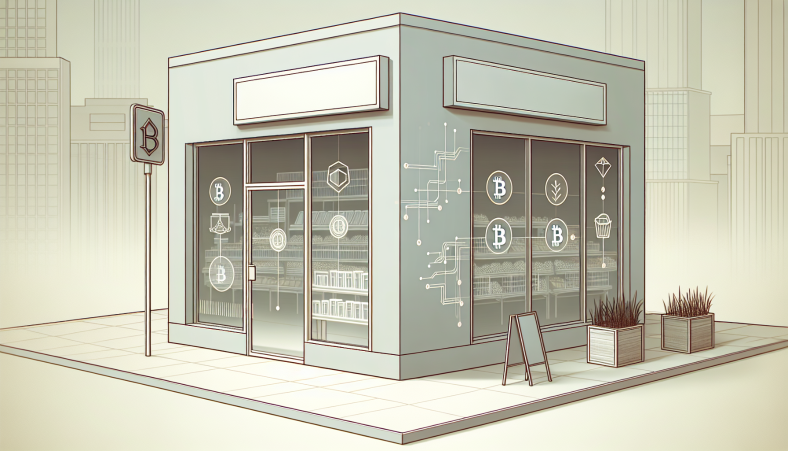
Polymarket Opens First Free Grocery Store in New York: While prediction markets are still widely perceived as "crypto casinos," the most effective customer acquisition method may not be a lower-latency trading engine, but rather a box of free tomatoes on the shelf. Article by ApNews, February 12, 2026. A special store appeared at 137 South 7th Avenue in New York's West Village. Named "The Polymarket," the sign reads: New York City's first free grocery store. Built by New Yorkers. For New Yorkers. Shelves are stocked with tomatoes, eggplants, milk, and bread; there's no cashier, and everything is free. This is the offline store that the cryptocurrency prediction platform Polymarket has been planning for months, accompanied by a $1 million donation specifically for the New York City Food Bank. On the same day, its competitor Kalshi had just finished a pop-up event: distributing $50 free food vouchers to citizens lining up at the West Side Market; the line snaked for several blocks, with nearly 1,800 people signing up. This isn't a charity's year-end greeting; it's two prediction market giants, with a combined valuation exceeding $20 billion, doing the same thing on the same street, within the same week. Source: X Twitter_Polymarket I. The Unfamiliarity Dilemma of Prediction Markets Prediction markets are an industry with inherent barriers to entry. It requires users to understand concepts like binary options, settlement oracles, and YES/NO share pricing, and to accept depositing funds into an on-chain contract and then betting on events such as whether the Federal Reserve will raise interest rates, the presidential election results, or whether a game will be released on schedule. Even if Polymarket achieves over $44 billion in trading volume, a valuation of $9 billion, and receives a $2 billion investment from Intercontinental Exchange (ICE), the parent company of the NYSE, by 2025, its total user base will still be less than 920,000. 920,000—that's the number of followers a top cryptocurrency blogger has on Twitter—but for a platform aiming to become the global prediction market infrastructure, this number is far from sufficient. Where are the real incremental users? Not on Wall Street, where Bloomberg Terminal already exists. Not in the crypto community, where it's already a red ocean. The real incremental users are like that New Yorker queuing outside the supermarket for eggs. He may have never heard of decentralized prediction protocols, but he knows that $50 worth of beef is enough for him for two days. When an industry is not yet understood by the public, a brand's greatest enemy is not competitors, but unfamiliarity. The most effective way to eliminate unfamiliarity is not to run more ads on social media, but to let someone truly connect with you.Citizens who receive free milk won't immediately become prediction market traders, but the next time they see the word "Polymarket" in the news, what comes to mind won't be some distant crypto casino, but the store where they received their tomato. II. The Divergence Between Physical Stores and Pop-up Stores The clash between Polymarket and Kalshi presents two drastically different strategic choices. Kalshi's strategy is typical of pop-up marketing: renting supermarket space, hanging prediction-themed banners, and hiring part-time workers in green hoodies to distribute stickers that read "Kalshi loves free markets," with the event lasting only three hours. This is a common viral marketing tactic used by Silicon Valley tech companies—efficient, low-cost, and easily replicable. Polymarket's choice is completely different. It didn't use any existing space; instead, it rented a store, obtained permits, and spent months preparing to open a truly physical store. The official announcement specifically emphasized that this wasn't a temporary pop-up booth, but a dedicated retail space planned and built from scratch over several months. Kalshi was vying for event buzz, while Polymarket was vying for cognitive capital. The pop-up event will end in three hours, the crowd will disperse, and the stickers will be tossed into drawers. But one store will continue to operate, a permanent Polymarket sign will appear on a street corner, and the $1 million donation will go into the New York City Food Bank's annual account and be mentioned in every future charity report. This is a shift in the competitive dimension from on-chain metrics to street narratives. When regulators and public opinion examine the prediction market industry in the future, a donation receipt bearing the seal of the city's food bank will be more persuasive than any trading volume data. III. Regulatory Game Extending from the Meeting Room to the Supermarket Door Discussing prediction markets inevitably involves regulation. In 2022, Polymarket was fined $1.4 million by the U.S. Commodity Futures Trading Commission and subsequently had its U.S. IP address blocked, effectively withdrawing from the domestic market. It only began its gradual return to the U.S. after receiving approval from the CFTC in 2025. But federal approval does not equate to state-level approval. New York State legislators are considering the ORACLE Act, which plans to impose strict restrictions on event-based prediction markets and even directly prohibit New York residents from participating in certain types of betting. Another piece of legislation requires prediction market operators to obtain a license from the state government to operate. Legislators' core concerns are insider trading, market manipulation, and ordinary users equating prediction markets with gambling without fully understanding the risks. In the past, prediction market platforms have dealt with regulation by hiring lobbying firms, submitting legal opinions, and explaining their technology at congressional hearings.These efforts are certainly necessary, but they only function within the meeting rooms of regulatory agencies. Polymarket's actions, however, extend the battleground from the meeting room to the supermarket entrance. Months later, when New York State legislators debate whether to pass the ORACLE Act, a letter from a resident might appear on their desk: Polymarket donated food to our community during the winter, their store is on Seventh Avenue, and there has never been any fraud or scam there. New York City Mayor Zohran Mamdani campaigned on a platform of opening public grocery stores in all five boroughs to lower food prices. Polymarket's free grocery store falls precisely on this extended policy narrative. It wasn't coordinated with the city government, nor did it need to. When a tech company's actions resonate with the claims of elected officials, public opinion naturally tilts in one direction. IV. Trust is the Most Expensive Compliance Cost in Prediction Markets. Returning to the initial question: Why would a prediction market platform distribute eggs offline? Breaking down all of Polymarket and Kalshi's actions, stripping away the charity packaging, brand marketing, and public relations rhetoric, the underlying logic is actually quite simple: ordinary people are hesitant to deposit money on a website they don't understand. Crypto wallets, private key management, on-chain gas fees, order book depth—these concepts represent a real cost of understanding for New York workers who work ten hours a day. The higher the cost of understanding, the higher the trust threshold. The higher the trust threshold, the more expensive customer acquisition. And offline promotion is, to date, the most rudimentary yet most effective way to overcome the trust threshold, repeatedly proven in the history of human commerce. Chinese internet companies validated this methodology a decade ago: offering a bag of rice for downloading an app, a carton of eggs for registering an account. Western tech elites once scoffed at this, considering it a crude, unscalable promotional tactic unbecoming of Silicon Valley brands. But today, ten years later, videos of New Yorkers queuing in the cold for $50 food stamps are essentially no different in business logic from the long lines outside Chinese community supermarkets back then. Whether it's blockchain or artificial intelligence, prediction markets or decentralized finance, all technology products aimed at mass consumers ultimately arrive at the same question: How do you get someone who has never heard of you to entrust their trust to you? Polymarket's answer is a free grocery store on Seventh Avenue. The tomatoes and eggplants on the shelves represent the industry's most expensive customer acquisition cost to date, and also the trust deposit the industry has to pay as it tries to move from niche geeks to mainstream applications.On February 12th, The Polymarket opened its doors. The temperature in New York City that day hovered around zero degrees Celsius. The fate of this store remained uncertain. How long would it operate? Would it face inventory and rent pressures like a regular retail store? How many of those who claimed the free food would ultimately become actual users on the platform? These questions were important, but at this juncture, they might not be Polymarket's primary concern. What it truly cared about was something else entirely: when the prediction market industry needed to defend itself someday, could it offer evidence more compelling than simply stating, "Our technology is advanced"? A $1 million donation receipt from the New York City Food Bank, a sign on Seventh Avenue, and the memories of thousands of citizens who received free milk—these were the chips Polymarket was currently accumulating. Whether these chips could translate into regulatory tolerance and public trust at a crucial moment remained uncertain. But at least the company had realized that in the game of financial innovation, compliance wasn't a legal issue, but a matter of trust. And trust was never earned in the office.
Polymarket’s Free Grocery Store: A Paradigm Shift in Crypto Adoption Strategy
In a move that signals a fundamental evolution in how crypto companies approach mainstream adoption, Polymarket has opened “The Polymarket,” New York City’s first free grocery store, accompanied by a $1 million donation to the New York City Food Bank. This strategic pivot from purely digital interfaces to physical community engagement represents one of the most innovative approaches to overcoming adoption barriers in crypto history.
Market Impact and Token Implications
This initiative creates a significant competitive advantage for Polymarket against its rival Kalshi, which opted for a temporary pop-up event rather than a permanent physical presence. The long-term positioning of Polymarket as a community institution rather than a transient promotion builds brand equity that transcends typical marketing metrics. For Polymarket’s native token (POLY), this could catalyze institutional interest by demonstrating a sophisticated understanding of regulatory and public perception challenges that have hindered prediction markets.
The strategy effectively transforms high customer acquisition costs into community assets. While the immediate financial impact may be negative due to operational expenses, the long-term token appreciation potential through increased user base and regulatory goodwill could substantially outweigh these costs. This approach validates a thesis that trust—rather than technology—is the primary bottleneck for prediction markets achieving mass adoption.
Strategic Implications
The grocery store represents a masterclass in repositioning perception. By associating Polymarket with tangible community benefits rather than abstract financial instruments, the company effectively counters the “crypto casino” narrative that has plagued prediction markets. This physical manifestation of digital value creates a powerful cognitive bridge for mainstream users who might otherwise be intimidated by crypto wallets and on-chain transactions.
The strategic divergence between Polymarket and Kalshi reveals a fundamental difference in philosophy: Polymarket is accumulating “cognitive capital” while competitors chase immediate buzz metrics. This positions Polymarket for sustained relevance rather than viral moments, potentially creating a moat around its brand that will be difficult for competitors to replicate.
Regulatory Opportunities and Risks
Perhaps most significantly, this initiative extends the regulatory battle from bureaucratic corridors to public consciousness. When New York legislators consider the ORACLE Act, the memory of Polymarket’s community contribution could serve as a powerful counterbalance to regulatory concerns about prediction markets being akin to gambling.
The alignment with Mayor Zohran Mamdani’s public grocery store initiative creates an organic resonance with existing policy narratives, potentially positioning Polymarket as a solutions provider rather than a regulatory concern. However, this strategy carries risks as well. The physical store could become a focal point for regulatory scrutiny, and there remains uncertainty about how many grocery recipients will actually convert to active prediction market users.
Broader Crypto Market Lessons
Polymarket’s experiment provides valuable lessons for the entire crypto ecosystem:
-
Trust as the Ultimate Commodity: In an industry where understanding barriers are high, physical trust-building may be more valuable than technological innovation.
-
Regulatory Arbitrage Through Public Good: Companies that align their services with public policy objectives may find regulatory tailwinds rather than headwinds.
-
Offline-to-Online Conversion: Traditional “offline-first” strategies may be more effective for crypto than purely digital approaches for certain demographics.
-
Community as Infrastructure: Building community goodwill can serve as a form of regulatory compliance that is more resilient than legal maneuvering alone.
As prediction markets continue to evolve from niche financial instruments toward potential mainstream infrastructure, Polymarket’s free grocery store may be remembered not as a marketing stunt, but as a pivotal moment when crypto discovered that sometimes the most effective on-chain strategy requires building something off-chain first.